
Perishability
A seven-day requirement for yoghurt or fresh cream should not automatically become a seven-day purchase. Delivery cadence and expiry risk matter.
Openfluid converts outlet-level menu demand into ingredient requirements using your recipes, then compares that requirement with usable stock. The result is a purchasing and transfer priority, not another inventory report.
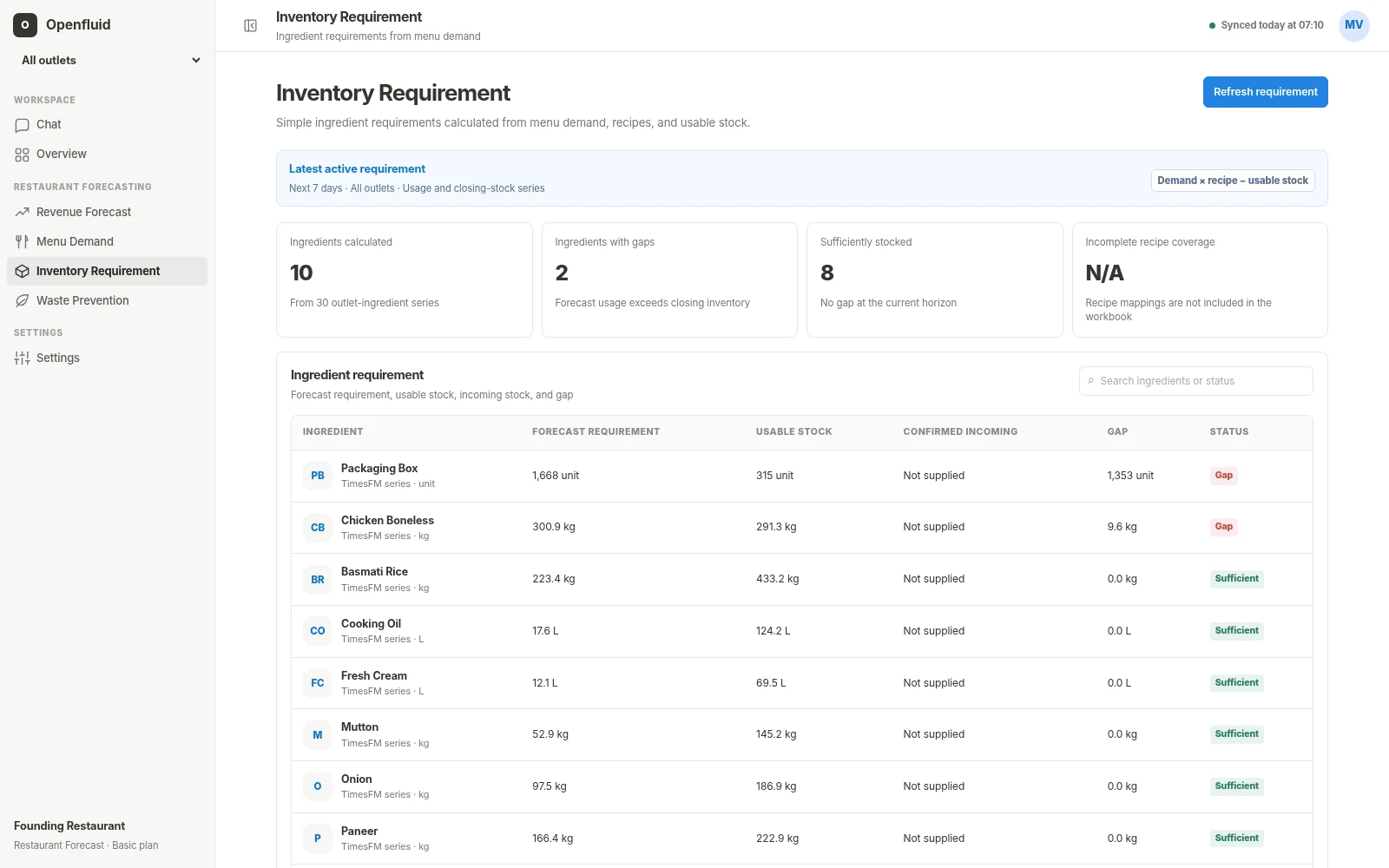
A transparent requirement is easier to challenge than a black-box purchase quantity.
The sample series indicates approximately 107.45 kg of expected usage over the next seven days. The latest recorded closing stock is 61.68 kg. Before safety stock, confirmed receipts and yield adjustments, that creates a visible gross gap of about 45.77 kg.
Synthetic sample data. A production recommendation would also account for open purchase orders, usable shelf life, recipe yield, transfer availability and supplier lead time.
Estimate menu-item demand for each outlet and service date.
Multiply expected portions by ingredient quantity, yield and unit conversion.
Subtract usable on-hand stock and confirmed inbound quantities.
Add safety stock, minimum order quantity, lead time and shelf-life constraints.
Buy, transfer, defer or review, along with the evidence behind the recommendation.
A seven-day requirement for yoghurt or fresh cream should not automatically become a seven-day purchase. Delivery cadence and expiry risk matter.
Gross ingredient weight, trim loss and cooked yield must be represented separately. Using a recipe’s purchase weight as serving weight can materially overstate demand.
One outlet’s shortage may be another outlet’s excess. Transfer recommendations should consider distance, handling cost and remaining shelf life.
Confirmed purchase orders and goods in transit must be netted before declaring a shortage. The forecast should not duplicate an order already on the way.
| Input | Minimum useful fields | Why it matters |
|---|---|---|
| Menu demand | Outlet, item, service date, forecast portions | Defines the dishes that drive consumption. |
| Recipe master | Item, ingredient, quantity, unit, yield, effective date | Translates dishes into ingredient quantities. |
| Inventory | Outlet, ingredient, usable closing stock, timestamp | Establishes what is available now. |
| Purchasing | Open PO quantity, expected receipt date, supplier | Prevents duplicate purchasing. |
| Operating rules | Lead time, safety stock, pack size, shelf life | Turns a mathematical gap into a practical action. |
The first release is designed to recommend quantities and expose the calculation. Automatic PO creation should be added only after approval rules, supplier mappings and exception handling are agreed.
Recipes need effective dates. Forecast demand for a future date should use the recipe expected to be active on that date, not an undated historical version.
Not always. Quarantined, expired, reserved or damaged stock should be excluded. A reliable implementation defines the usable-stock rule with the operator.
Yes, when comparable units, shelf life, transfer time and source-outlet safety stock are available. The transfer should be evaluated against purchasing, not shown as a free alternative.
Share one outlet’s menu history, recipe export and closing inventory. We will identify what can be forecast immediately and which controls are still missing.