
Are holidays, closures and local events represented?
A recurring weekly pattern will miss exceptional demand when the event is absent from the future calendar.
Forecast net revenue and completed orders separately, then examine average order value, outlet contribution and the uncertainty around the estimate.
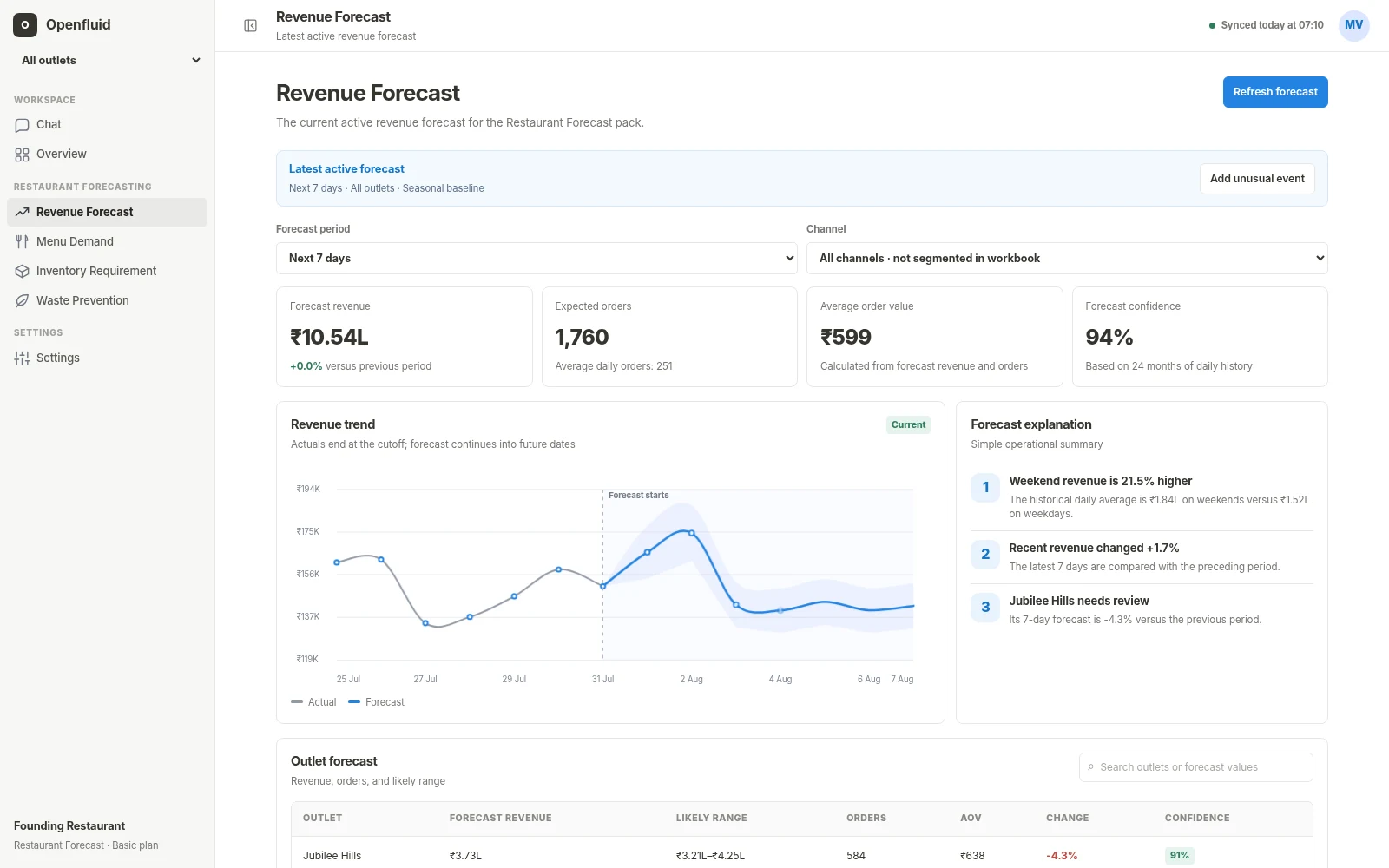
The product should expose the components behind the forecast rather than compressing them into a single KPI card.
Openfluid keeps revenue and order count as separate series. That matters because a revenue increase driven by more orders requires a different operating response from an increase driven by larger baskets. Staffing, production and packaging follow volume; cash planning follows revenue.
This is a model-simulation example from the attached workbook, not a claim of customer accuracy or growth.
The previous seven days recorded ₹10,35,489, so the historical comparison is approximately +1.7%. Jubilee Hills contributed ₹3,89,678, Gachibowli ₹3,73,764 and Madhapur ₹2,90,161.
For Saturday, 1 August, a same-weekday seasonal baseline produces ₹1,68,622 and about 281 orders: ₹61,126 at Jubilee Hills, ₹59,089 at Gachibowli and ₹48,407 at Madhapur.
Forecast error is only meaningful when the team knows which information was available at prediction time.
A recurring weekly pattern will miss exceptional demand when the event is absent from the future calendar.
A low-sales day caused by an outage should not be interpreted as low demand without an availability signal.
A forecast produced after pre-orders arrive has more information than one produced the night before. Evaluation must use the same cut-off.
Compare against a seasonal naïve forecast and the operator’s current method, not only against an arbitrary accuracy target.
These boundaries should appear in product copy because they directly affect the buyer’s expectation.
Profit is not revenue. Recipe cost, labour, aggregator commission, discounts and refunds are required before contribution margin can be estimated.
Correlation is not causation. A forecast can use promotions and events as inputs, but it should not claim that a campaign caused an outcome without a suitable analytical design.
A range is not a guarantee. Confidence intervals describe model uncertainty under observed patterns; they do not cover every disruption, closure or supply constraint.
Forecast both. Orders are closer to workload and preparation volume; revenue captures basket size and price effects. Their relationship helps explain the result.
Yes when the source provides reliable channel labels and net values. Channel commissions and settlement timing remain separate inputs.
Tomorrow and seven days are usually operational. Monthly forecasts are useful for finance, but require a different evaluation and may use different drivers.
The next page shows how total demand is allocated to the menu and converted into a preparation decision.